BranchSight
Turns the CCTV cameras a restaurant or shop already has into live operational numbers, without identifying anyone.
What it does
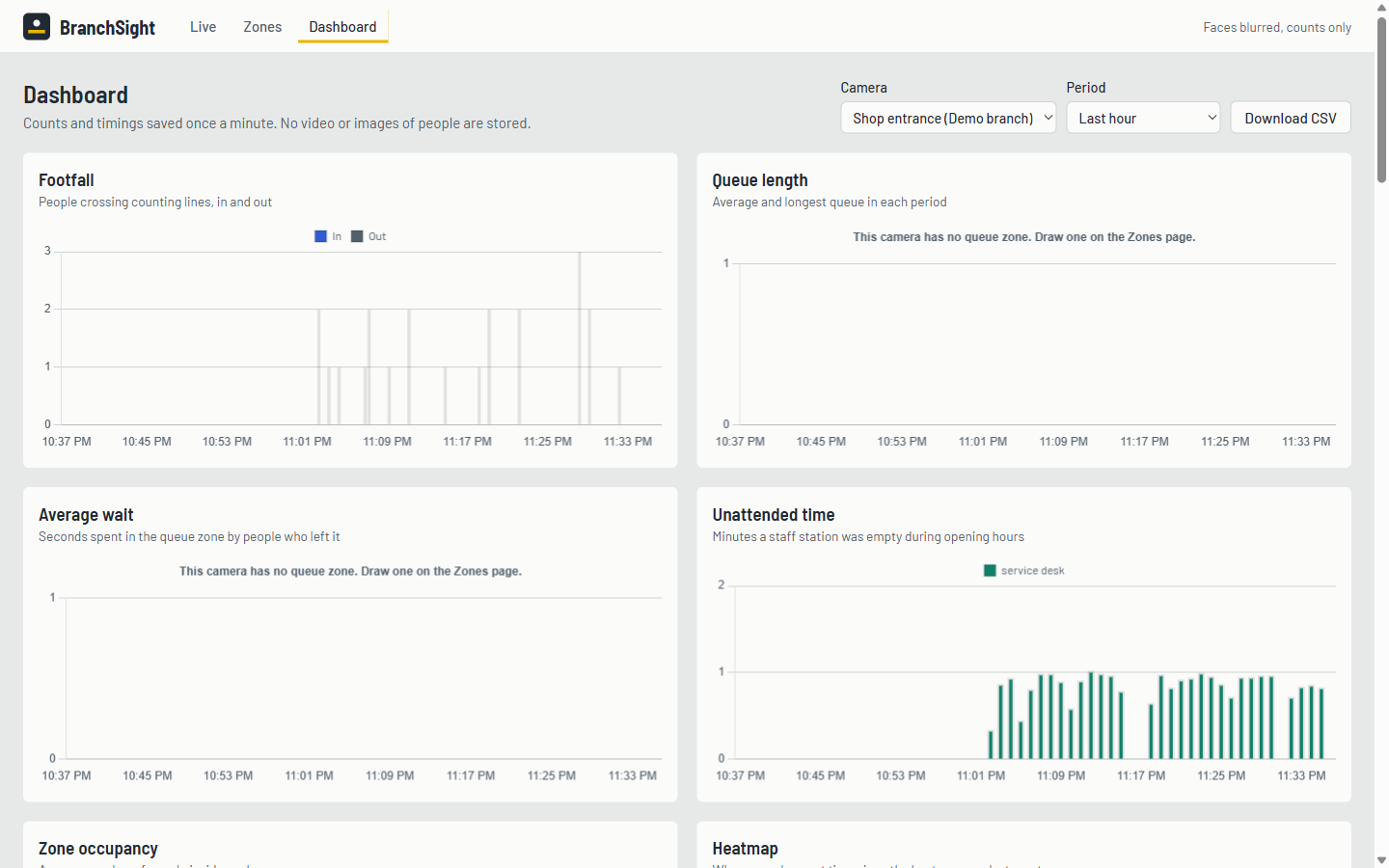
Chains have cameras in every branch, but nobody watches them. BranchSight watches the feeds continuously and answers the questions a branch manager actually asks: how many people came in, how long the queue is, whether the counter has been left empty, and where customers spend their time.
Footfall
Counts people crossing a line drawn across the door, in each direction, minute by minute.
Queue and wait time
Measures how many people are waiting at the counter and how long they waited. Raises an alert if the queue stays too long.
Unattended counter
Alerts when nobody has been behind the counter for a set time during opening hours. It checks presence, never who.
Heatmap and dwell
Shows which parts of the floor people spend time in and the average time spent in each zone.
What it looks like


How it works
Each camera has its own worker. It always takes the newest frame, so delay never builds up. It finds people, follows each one across frames with a temporary ID, updates the counts, and pixelates faces before the frame goes to the browser. Only per-minute numbers and alert events are saved.
Privacy by design
- No identification. No face recognition and no matching people across cameras or days. A person's ID exists only while they are in view.
- Faces never leave the server. Every frame shown or saved has detected faces and the head area of every person pixelated, on by default.
- Numbers, not video. The database holds per-minute counts and alert events only, and deletes them after 30 days.
- Staff analytics are presence-only. The unattended alert checks whether anyone is at the counter, not who.
Results
Every number here comes from a script in the repository and can be re-run. The weak results are reported along with the strong ones.
Tracking accuracy on MOT17
MOT17 is the standard public benchmark for following people in video, with every person hand-annotated. The system was run on all 7 training sequences and scored with an evaluator that matches the official TrackEval rules. The detector is the off-the-shelf nano model; it was not trained on this data.
Almost all errors are missed people (82,559 missed boxes against 2,299 false alarms), mostly small and distant figures in crowded scenes. Giving the model more pixels helps more than a bigger model, but costs 2.3x the compute. On the shop-entrance sequence the default setup scores MOTA 56.4.
Counting accuracy
Instead of counting by hand, the true number of line crossings was computed by running the same counting code over the benchmark's annotated tracks. That gave 76 real crossings on 8 lines across the three fixed-camera sequences.
| Setup | Crossings counted (true: 76) | Total error |
|---|---|---|
| Nano model, 640 px (default) | 50 | -34% |
| Small model, 640 px | 69 | -9% |
| Nano model, 960 px | 74 | -3% |
At 960 px the total is close, but individual lines are still off in both directions, so per-line accuracy is lower than the total suggests. The sample is small.
Speed
| Hardware | Setup | Time per frame (median) |
|---|---|---|
| Laptop CPU (AMD Ryzen AI 9 HX 370) | PyTorch, detection only | 51.1 ms |
| Laptop CPU | ONNX Runtime, detection only | 29.0 ms |
| Laptop CPU | Full pipeline, one camera | 44.4 ms (21.9 FPS) |
| Laptop GPU (RTX 5070 Ti) | PyTorch, network only, 1 frame | 18.9 ms |
| Laptop GPU | PyTorch, network only, 3 cameras batched | 9.0 ms per frame |
| Cloud VM (2 shared vCPUs) | Full pipeline, one camera | 274 ms (3.2 FPS) |
- The app ships with ONNX Runtime on CPU: it is 1.76x faster than PyTorch and keeps the server image free of PyTorch.
- On the GPU, a single frame takes about 19 ms whatever the image size, which means the time goes on launching work from Python, not on the GPU itself. Batching three cameras into one call doubles throughput. A compiled TensorRT engine is the next step.
- The public demo runs on the smallest practical cloud machine, so each of its three cameras gets about one frame per second. It works, but counts there are coarser than on a laptop.
Engineering
- One Python service: per-camera worker threads, a REST API, live video streams, a WebSocket for live counts, and a three-page web app with no build step.
- Streams reconnect on their own with exponential backoff, and tracking restarts cleanly after a reconnect so no false counts appear.
- Storage is SQLite by default or Postgres through one setting, with a 30-day retention job.
- One Docker image with the model export in a separate build stage, deployed to Google Cloud with a single script.
- 55 automated tests cover counting logic, zones, alerts, privacy pixelation, the API, and an end-to-end run on real footage.
Limitations and next steps
- The off-the-shelf detector misses small and distant people. Fine-tuning on CCTV-angle footage, with a before-and-after comparison, is the next step.
- GPU inference with TensorRT and batching across cameras, and running on edge devices so video never leaves the branch.
- The demo uses plain HTTP and a single admin password; a production deployment needs HTTPS and proper user accounts.
Demo footage: MOT17 sequences from MOTChallenge (CC BY-NC-SA 3.0, non-commercial) and a Pexels stock clip, both with faces pixelated. The code is AGPL-3.0 because it uses Ultralytics YOLO.